

Auto-Detect Applications & Workloads
Auto-Detect is the AI Assistant that discovers potential application workloads from your software inventory and infrastructure patterns. Instead of building every application by hand, you let the assistant propose the workloads it sees, then review and confirm them. It's the fastest way to get a first picture of the estate.
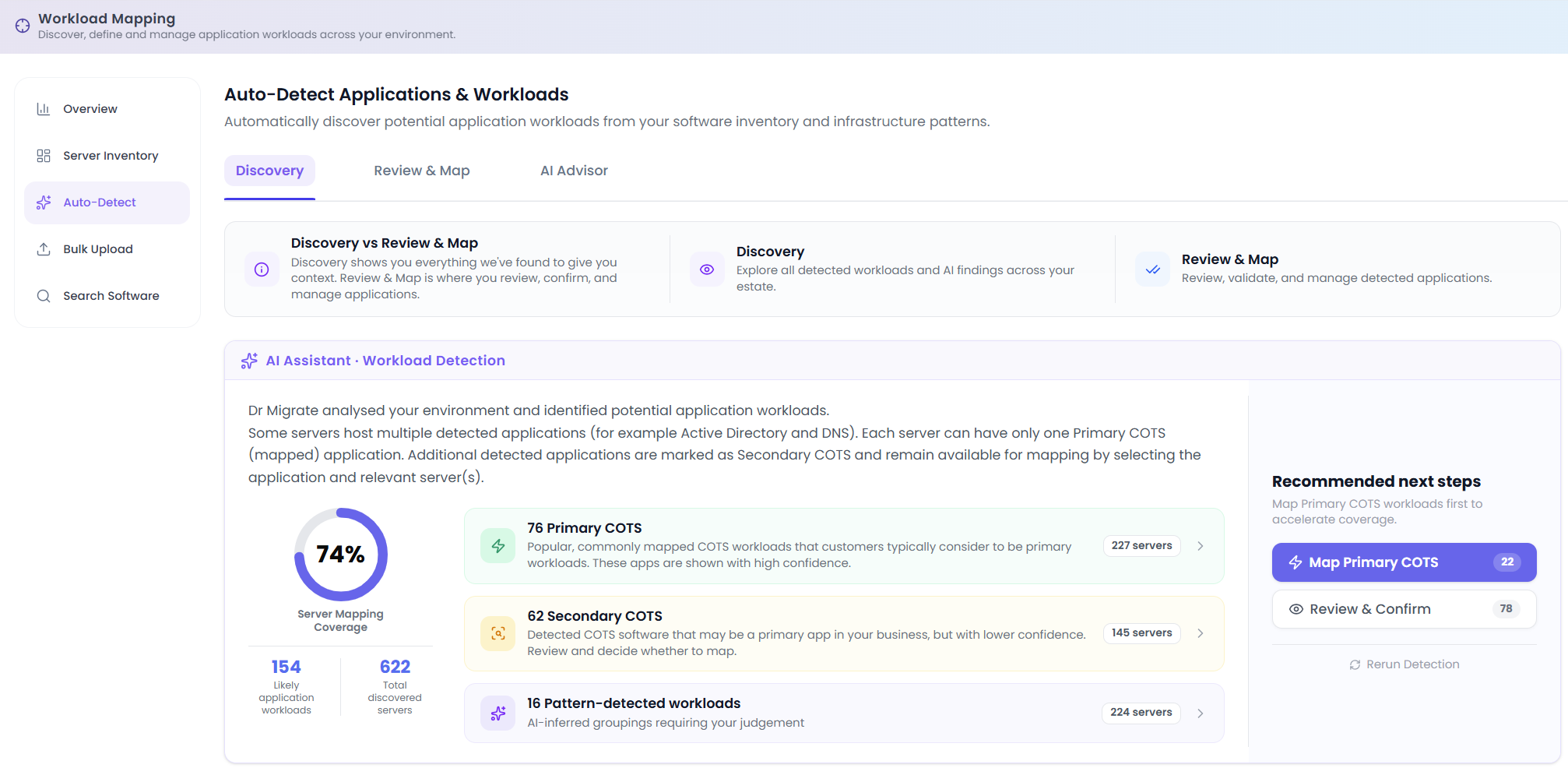
The AI Assistant panel
The AI Assistant · Workload Detection panel sits at the top and summarises what the assistant has found: your Server Mapping Coverage %, the number of likely application workloads, and the total discovered servers it analysed. Findings are sorted into three confidence buckets so you know how much to trust each one:
Auto-Detect never overwrites your existing mappings without permission, and you can Rerun Detection at any time as your data improves. All analysis happens inside your Dr Migrate instance.
| Bucket | What it means |
|---|---|
| Primary COTS | Primary commercial off-the-shelf software identified with high confidence, safe to map in bulk. |
| Secondary COTS | Additional off-the-shelf products identified with slightly lower confidence; review before mapping. |
| Pattern-detected workloads | Workloads inferred by the AI where no known software signature was found; these need your judgement. |
Three recommended next steps are offered alongside: Map Primary COTS (accept the safe bucket in one move), Review & Confirm (work through suggestions individually), and Rerun Detection (re-analyse after your data has improved).
For the best results, Bulk Upload any CMDB data you have first. Auto-Detect gives you a strong first pass on its own; a CMDB import improves coverage further.
Discovery, Review & Map and AI Advisor
The screen has three tabs. Discovery is for exploring everything the assistant found; Review & Map is for deciding what to do with each finding; and AI Advisor brings the AI Advisor directly into the workload-mapping workflow.
Discovery
The Discovery tab lets you explore everything detected, grouped into logical category domains covering infrastructure tooling, security, collaboration, business applications, and AI-inferred groupings. Each domain shows its detected applications with server counts and how many are already mapped versus how many still need review. Filter and search across the domains, and switch between All, Mapped and Unmapped to focus on what still needs work.
Review & Map
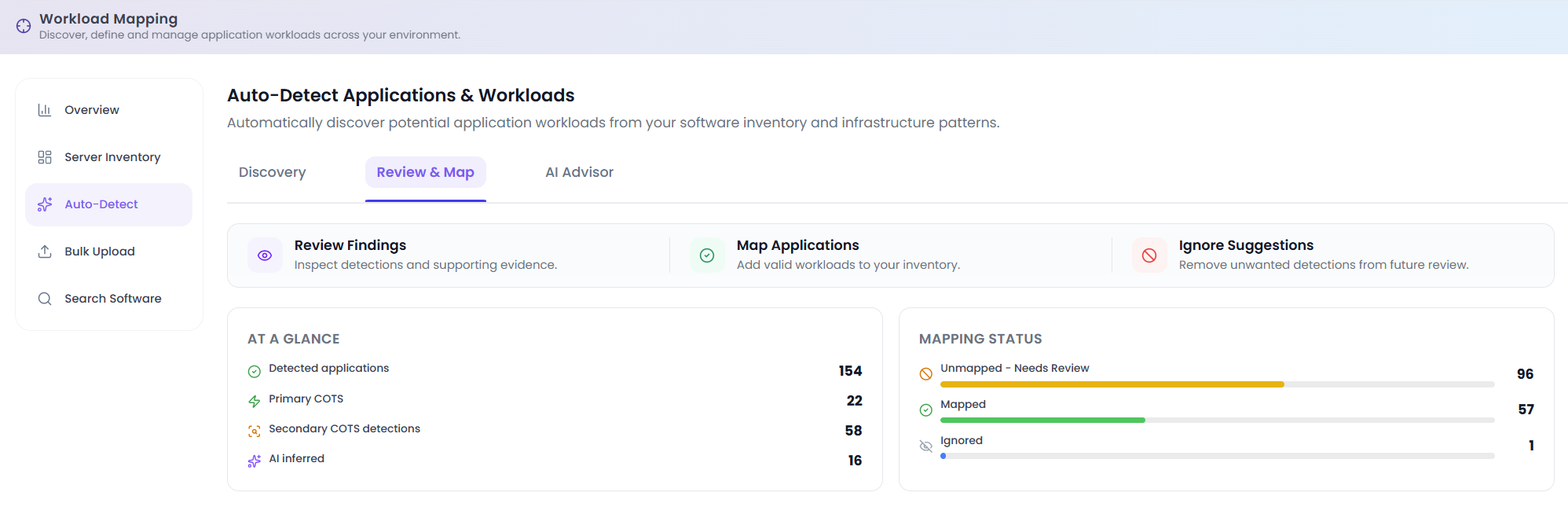
The Review & Map tab is where you review findings, map applications and ignore suggestions you don't want. Two summary panels frame the work: AT A GLANCE (counts of Detected applications, Primary COTS, Secondary COTS detections and AI Inferred findings) and Mapping Status (how many are Unmapped / Needs Review, how many are Mapped, and how many are Ignored).
Two Quick Actions let you move fast: Bulk Assign to map a whole group of findings at once, and Unmap All to clear suggestions and start over.
Every action here is reversible: mapped findings can be unmapped from the detail drawer, ignored suggestions can be brought back using Unignore under the "Show ignored" filter, and Unmap All asks for confirmation before it runs.
Below, a tabbed list switches between Needs Review and Mapped. For each row you can:
| Action | What it does |
|---|---|
| Map | Accept the suggestion and assign the servers to the application. |
| Ignore | Dismiss the suggestion so it stops appearing in your review list. |
| View | Open the finding to see the proposed application, the servers the AI thinks belong to it, and the evidence behind the suggestion, then confirm to Map. |
You can also bulk-map a whole bucket at once rather than working row by row.
AI Advisor
The AI Advisor tab surfaces the AI Advisor directly inside the workload-mapping workflow, so you can ask questions about detected applications or get mapping suggestions without leaving the screen. See AI Advisor for full documentation of its capabilities.
Recommended approach
Bulk upload first
Import any CMDB data with Bulk Upload so the AI has examples to learn from before it runs.
Map the Primary COTS bucket
Use Map Primary COTS to accept the safe suggestions in one pass, giving instant coverage with little risk.
Review the rest
Work through the Secondary COTS and pattern-detected buckets in Review & Map, using View to check the servers and signals before you Map or Ignore.
Rerun and refine
Rerun Detection after changes, and use Server Inventory to resolve anything still unmapped.
Troubleshooting
Coverage % lower than expected? Bulk Upload any CMDB data you have, then use Rerun Detection to refresh results.
An application wasn't detected? Add it manually from the Review & Map tab, or include it in a CMDB import and rerun detection.
Detection results changed after a rerun? This is expected. Auto-Detect re-evaluates against your current data each time you run it. Review the updated findings in Review & Map before confirming any changes.
Next step
After Auto-Detect, refine coverage in Server Inventory, or validate a specific product's footprint with Search Software.